
The ADHD Doom Pile Fix: Sort by Next Move, Not Perfect Home

A doom pile is not proof that you are lazy. It is usually proof that too many small decisions showed up at once.
Mail. Receipts. Chargers. Random returns. A notebook you meant to use. Three things that belong upstairs. One thing you do not know what to do with.
Now the pile looks stupid. But the real problem is not the pile. The real problem is that every object is asking a hard question at the same time.
Where does this go? Do I keep it? Do I need it today? Should I deal with it now or later? What if I put it away and forget it exists?
That is a lot of executive function for one kitchen counter.
Recent public ADHD chatter keeps circling the same pain point from different angles. Reddit is full of doom-pile threads. YouTube is full of declutter rescue videos. ADHD experts keep coming back to the same root problem too: too many tiny decisions can eat the brain before the actual cleanup even starts. The pattern is boringly consistent for a reason.
Doom piles are delayed decisions
A lot of clutter advice starts too late. It starts at color-coded bins, labels, and room makeovers.
Most ADHD doom piles start earlier than that. They start at the tiny moment where your brain has to decide the next move for one loose item.
If the next move is not obvious, the object stalls. Then another object stalls. Then another. Then you have a pile that looks like a motivation problem when it is really a routing problem.
That is why doom piles can grow even when you care. Even when you notice them. Even when the mess is actively stressing you out.
You are not ignoring the pile because you love chaos. You are avoiding a wall of tiny decisions.
Stop sorting by perfect home
If you try to solve the whole pile by finding the perfect permanent home for every item, you will probably bounce. That is too many decisions for one pass.
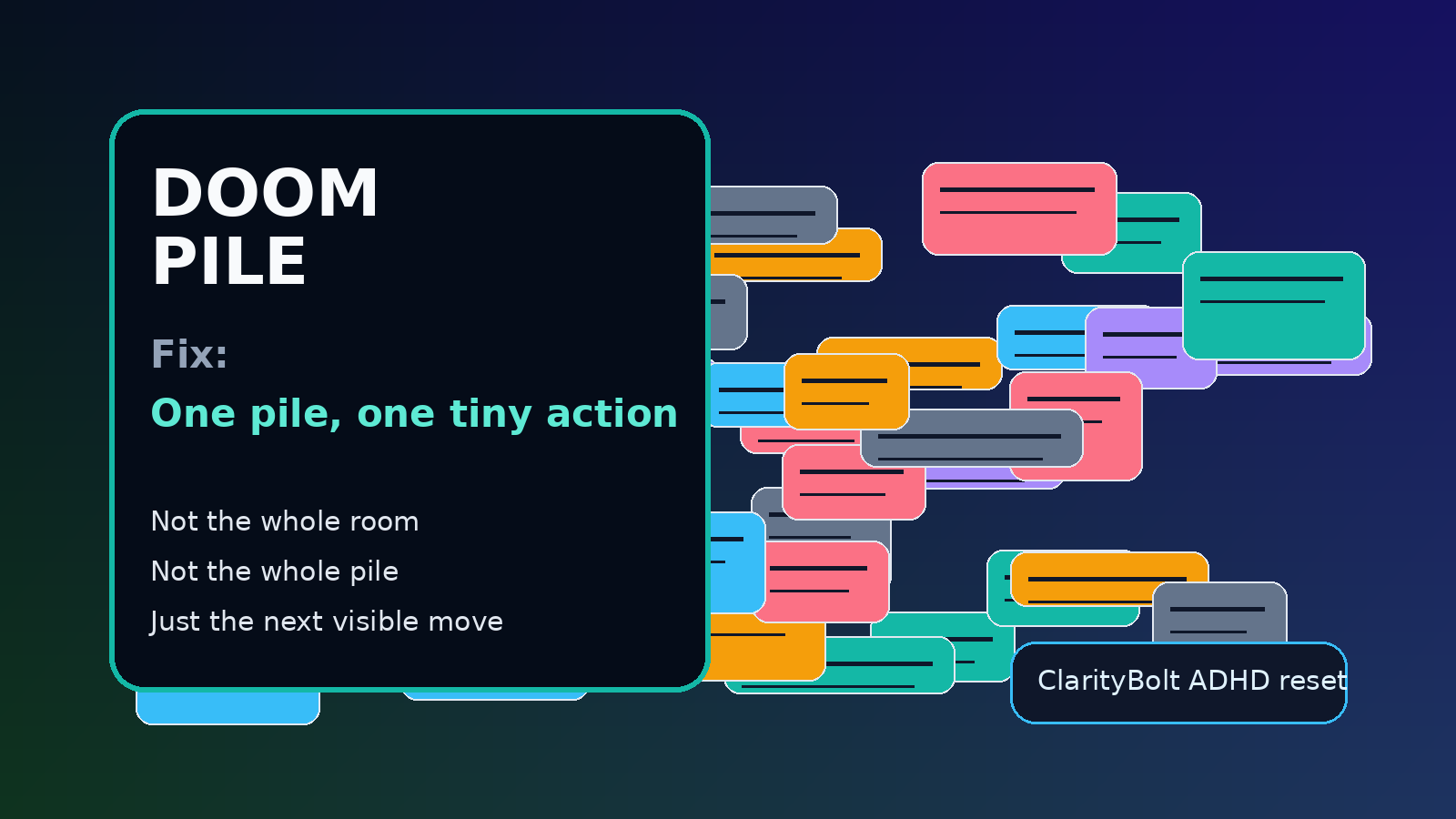
Instead, sort by next move. Not perfect home. Not forever system. Just next move.
That means each item only needs one answer right now: What happens next?
Use the 3-bucket reset
Grab three containers, trays, bags, or baskets. Nothing fancy.
Make them:
- put away
- needs action
- trash or exit
That is enough.
Now go through the pile one item at a time. Not to finish your life. Just to give each item a next move.
1. Put away
This is for things that already have a home. Keys. Headphones. A charger. Scissors. That shirt that belongs in the bedroom.
Do not stop to walk every item back one by one if that breaks momentum. Just route them into the put-away bucket first.
You are reducing decision load. Not creating a Pinterest closet.
2. Needs action
This is where most ADHD doom piles get sticky.
Mail to open. Paper to file. Something to return. A form to sign. A cable you need to test. A notebook page with info you still need.
These items are not homeless. They are unfinished.
That matters. Because unfinished items need an action plan, not a prettier container.
3. Trash or exit
Broken packaging. Junk mail. Empty boxes. Expired papers. The weird cord you have already kept through three moves.
You do not need a moral trial for every object. Sometimes the next move is just out.
Why this works better for ADHD brains
This method shrinks the job. A lot.
You are not asking:
- where should this live forever?
- how do I organize this whole room?
- what is my ideal system?
You are asking:
- what happens next?
That is a smaller question. Smaller questions are easier to answer. And easier-to-answer questions create motion.
That lines up with what keeps coming up in ADHD discussions and expert commentary too: clutter is often less about being "bad at cleaning" and more about decision fatigue, distractibility, working-memory overload, and too many unresolved categories at once.
The rule that keeps the pile from coming back tomorrow
Your needs-action bucket cannot become a prettier doom pile. It needs a follow-up rule.
Try one of these:
- handle five items from it at 4:30 PM
- open all paper from it after lunch
- do one return, one paper, and one admin item tonight
- put it beside your main planning spot so it gets reviewed on purpose
The bucket is allowed. The mystery is not.
What to avoid
Doom-pile cleanup usually fails when you do this:
- trying to organize the whole house in one burst
- mixing sentimental stuff into a quick reset
- making ten categories too early
- walking away every time an item needs a separate trip
- expecting yourself to finish when your brain is already cooked
Keep the pass brutally simple. Routing first. Deep organizing later.
A 10-minute version for bad brain days
If the pile feels heavy, do this:
- set a 10-minute timer
- grab the 3 buckets
- sort only the visible top layer
- stop while you still have a pulse
You do not need to finish the whole pile to break the spell. You just need visible progress.
One simple rule
When clutter starts turning into a doom pile, stop asking every object where it should live forever. Ask what it should do next.
That question is smaller. Smaller is what gets done.
If you want a fast gut-check on the kind of ADHD friction that keeps tripping you, take the ClarityBolt quiz:
https://www.claritybolt.com/quiz
And if paper tasks, loose notes, and open loops keep turning into physical or mental piles, the ClarityBolt ADHD productivity planner, Mission Control, gives them one trusted place to land:
Sort by next move. Then let the pile get smaller.
try the tool
Ready to try Mission Control?
A dark-themed daily dashboard for Excel and Google Sheets. $24.99.
See everything included before you buy