
The ADHD One-Drawer Reset: Reduce Clutter Without Starting a Whole Room
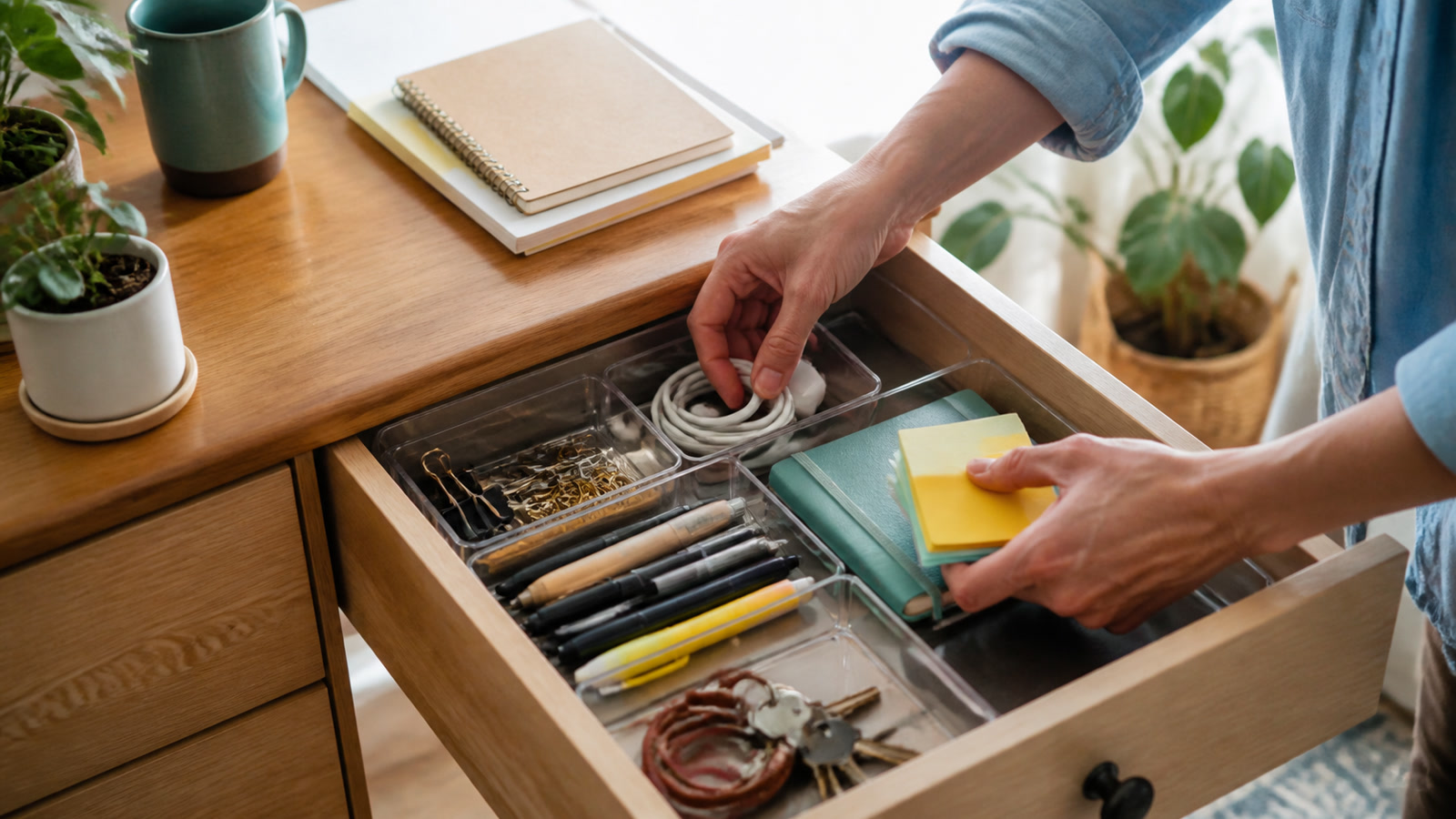
Clutter gets intimidating when your brain turns it into a whole-room problem.
You look at the desk, the counter, the bag, the drawer, the mail pile, and the random objects that do not seem to have a home. Suddenly the task is not "put a few things away." It is "fix the house, become organized, and maintain a system forever."
That is too big.
For an ADHD brain, the way back into organization often has to be smaller than the mess. One drawer is small enough to start. One drawer is also useful enough to matter.
Use a one-drawer reset when clutter is bothering you, but cleaning the whole room would turn into avoidance, wandering, or a three-hour side quest.
Pick the drawer that creates daily friction
Do not start with the most embarrassing drawer.
Start with the drawer that keeps interrupting normal life.
Good candidates:
- the desk drawer where pens, chargers, receipts, and sticky notes disappear;
- the kitchen drawer that makes every meal start with digging;
- the nightstand drawer where medication, cords, glasses, and old wrappers collide;
- the entry drawer where keys, batteries, coupons, and mystery objects pile up;
- the work bag pocket that acts like a portable junk drawer.
The question is not "Which drawer should a more organized person fix?"
The question is "Which drawer makes tomorrow slightly harder when it stays like this?"
Choose that one.
Empty only enough to see
You do not need to dump the whole drawer onto the floor if that will create a bigger mess than you can recover from.
Pull out enough to see what is actually in there.
Make three small zones:
- keep here;
- move somewhere else;
- trash or recycle.
That is it.
Do not add categories for every possible item. The more categories you create, the more decisions you have to make. The goal is not a perfect inventory. The goal is to make the drawer less hostile.
Remove the obvious junk first
Start with decisions that are barely decisions.
Throw out or recycle:
- dried pens;
- empty wrappers;
- expired coupons;
- broken rubber bands;
- scraps with no useful information;
- duplicate packaging;
- receipts you do not need;
- random pieces that belong to nothing you own.
This step works because it creates visible progress without asking your brain to solve the hard stuff first.
ADHD organization often fails when you start with the emotionally loaded item. Do the obvious items first. Let momentum show up after the drawer has more air in it.
Give the drawer one job
Now decide what this drawer is for.
Not five jobs. One main job.
Examples:
- writing tools;
- daily tech;
- medication and bedtime items;
- keys and leaving-the-house basics;
- mail tools;
- craft supplies;
- work setup.
If the drawer has one job, your future decisions get easier. Anything that does not support that job has to earn its spot.
You are not trying to build a showroom drawer. You are giving your future self a place where the right things are easier to find.
Use containers you already have
Do not stop the reset because you do not have the perfect organizer.
Use what is already nearby:
- a small box;
- a mug;
- a zip bag;
- a clean food container;
- a rubber band;
- an envelope;
- a folded piece of cardboard as a divider.
Buying organizers before the drawer has a job can become another avoidance loop. First, reduce the mess. Then you can decide if the drawer actually needs anything.
Most of the time, it needs fewer objects more than it needs a fancy tray.
Put the useful item in the easiest spot
Every drawer has one or two items you reach for constantly.
Put those where your hand naturally goes first.
If you open the desk drawer for a pen, the pen should not be under receipts, chargers, and old business cards. If you open the nightstand for medication, it should not be behind random cables.
This sounds obvious, but it matters.
ADHD friction is often the tiny gap between "I know it is in here somewhere" and "I can use it right now." Close that gap on purpose.
Make a tiny exit plan
Before you stop, look at the "move somewhere else" pile.
Do not walk all over the house putting everything away one by one. That is how a small reset turns into a wandering project.
Put those items in one small carry pile or container. Move them in one lap.
If something does not have a home, make a temporary home and write down the decision for later.
Temporary is allowed. The drawer reset does not have to solve your entire storage system today.
Stop when the drawer is usable
The stopping point is not perfection.
The stopping point is this:
- obvious trash is gone;
- the drawer has one main job;
- the most-used item is easy to reach;
- the leftover items have a next place to go.
That is a finished reset.
You can improve it later, but you do not have to keep going just because you started.
One usable drawer is better than a whole room pulled apart at 10 p.m.
Try it today
Set a 15-minute timer.
Pick one drawer that creates daily friction.
Remove the obvious junk.
Give it one job.
Put the most-used item where you can reach it first.
Then stop.
If clutter keeps turning every small task into a wall, take the ClarityBolt quiz to find out whether your biggest friction is clutter, time blindness, task paralysis, or too many open loops.
Take the ClarityBolt quiz:
https://www.claritybolt.com/quiz
And if you want one ADHD-friendly place to keep the next visible step in front of you without building a complicated system, the ClarityBolt ADHD planner, Mission Control, was built for that: https://www.etsy.com/listing/4492993377/mission-control-adhd-friendly-daily?ref=shop_home_active_1&dd=1&logging_key=b12b93453a7ccaa085484f2a615fdaebbb18ffa0%3A4492993377
choose the help that fits
When reading is not enough, take one contained next step.
Use Restart Rescue for a stalled project, Workday Rescue for a tangled day, One-Room Reset for one overwhelmed space, or the $20 Rescue Hub for all three.
Prefer to watch? Visit ClarityBolt on YouTube