
The ADHD Re-Entry Note: The One-Sentence Handle That Gets You Back In

A lot of ADHD advice is about starting.
Fair. Starting is hard.
But a different problem quietly wrecks a lot of days after you already started: getting back in.
You were doing the task. Then a text hit. A Slack ping landed. A kid needed something. You stood up for water and your brain wandered off like it got a better offer.
Now the task feels weirdly far away.
That is where people usually make it worse. They try to remember everything. They reopen six tabs. They reread half the doc. They scold themselves for losing momentum.
A better move is smaller. Leave yourself one re-entry note.
What a re-entry note actually is
A re-entry note is one sentence that tells future-you exactly where to grab the task again.
Not a journal entry. Not a motivational speech. Not a full recap.
Just a handle.
Good re-entry notes sound like this:
- reply with the new timeline and ask for approval
- finish the second paragraph under pricing
- pull the three numbers from the invoice tab
- open the form and upload the receipt
- restart by outlining section 2
That is enough.
The note does not finish the work. It removes the expensive part where your brain has to reconstruct the work.
Why interruptions cost so much with ADHD
The interruption itself is not always the real problem. The rebuild is.
When ADHD focus breaks, you often lose:
- the exact next step
- the logic chain you were holding
- the emotional tolerance you had for the task
- the tiny working-memory details that made the task feel doable
So when you come back, you are not continuing. You are rebuilding the runway.
That is why a two-minute interruption can burn the next half hour. You are not lazy. Your brain lost the thread.
The fix: leave the thread where you can see it
Before you switch tasks, write one line. That is the whole move.
Use this shape:
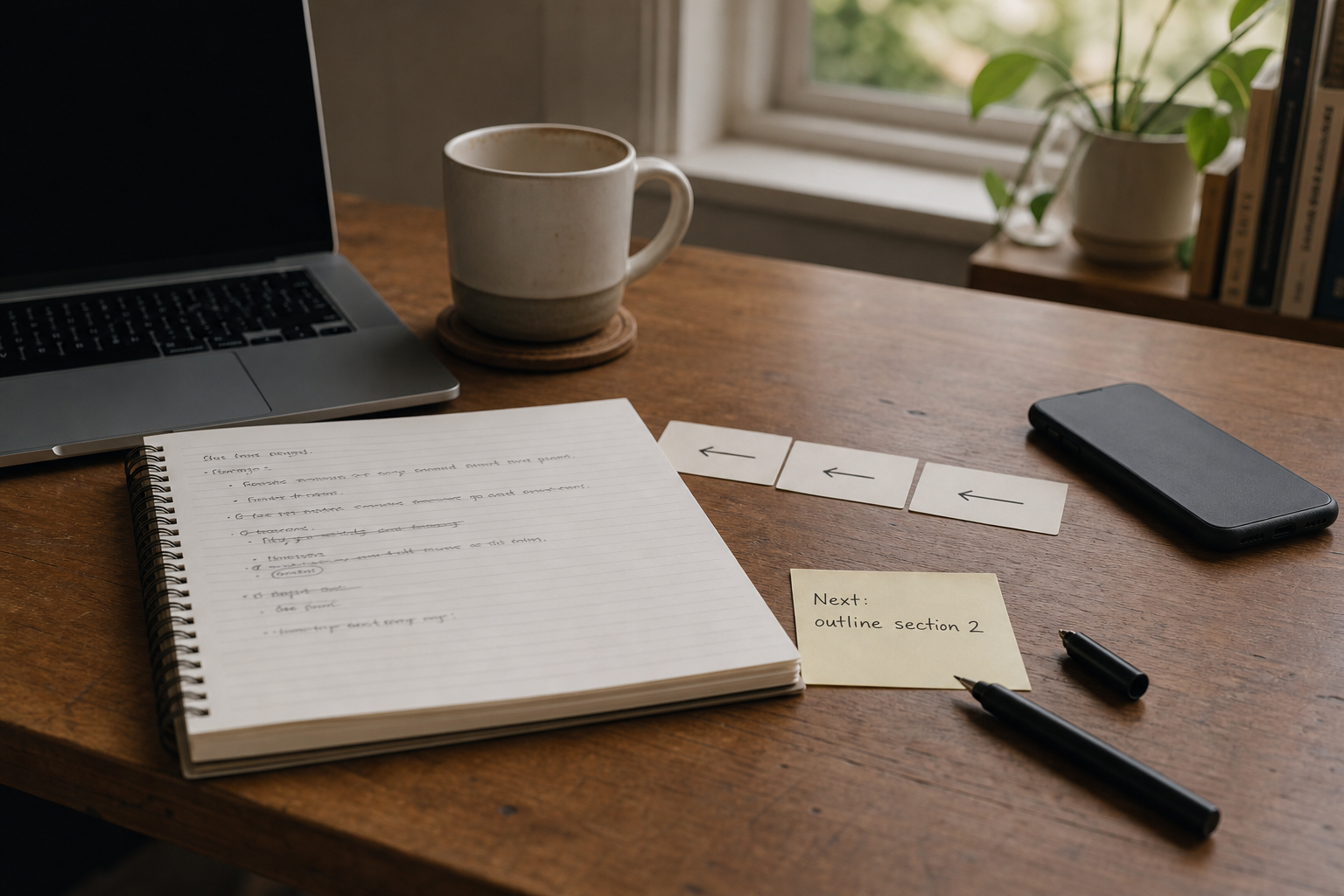
**Next: [tiny visible action].**
Examples:
- **Next:** send the first sentence of the client update
- **Next:** read the last three bullets and write one more
- **Next:** reopen the budget sheet and highlight the missing numbers
- **Next:** outline section 2 before checking anything else
The smaller the note, the better.
Big notes become homework. Small notes become handles.
What makes a good re-entry note
A good re-entry note is:
1. **Specific** — not “work on project,” but “write the opening sentence” 2. **Visible** — somewhere you will actually see it 3. **Tiny** — small enough to restart without negotiation 4. **Action-first** — a move, not a thought
Bad re-entry notes sound like this:
- get life together
- finish the project
- fix everything
- catch up today
That is not a note. That is a threat.
Where to keep it
Pick one place. Not seven.
Good options:
- one sticky note on the desk
- one notebook line
- one note app called “next”
- one planner box for restart cues
- one spot inside Mission Control for the exact next move
The goal is not to create a beautiful system. The goal is to stop making every interruption feel like a cold restart.
What this looks like in real life
Let’s say you were writing a proposal and got pulled into a call.
Instead of leaving the doc mid-thought and trusting memory, leave:
**Next: write the pricing paragraph before opening inbox.**
Or maybe you were cleaning and got sidetracked by three other rooms. Leave:
**Next: clear the counter only. Do not migrate.**
Or maybe you were doing admin work and your brain bailed after one annoying email. Leave:
**Next: reply with two sentences. No perfect rewrite.**
These notes work because they cut through the fake drama. They tell your brain where the floor is.
The no-shame rule
Do not use the re-entry note to guilt yourself.
Not:
- you should have finished this by now
- do not get distracted again
- seriously, just do it this time
That kind of note turns the task radioactive.
Use neutral language. Boring is good. Boring restarts better than emotional.
If you keep forgetting to leave the note
That is normal. So make it easier:
- keep the notebook open near the laptop
- leave one pen there on purpose
- put a sticky pad where your eyes already land
- make “leave the note” part of standing up
A lot of ADHD support is just making the good move easier than the random move.
This is one of those cases.
A simple script for the moment you get pulled away
Say this:
> I do not need to hold the whole task in my head. I just need to leave myself the next handle.
That line helps because it lowers the job. You are not preserving your entire brain state. You are leaving a breadcrumb.
Breadcrumbs beat memory heroics every time.
CTA
If interruptions keep knocking you sideways, take the ClarityBolt quiz and figure out which kind of ADHD friction is actually costing you time.
And if you want one clean home base for your next moves, Mission Control helps you keep today visible so re-entry does not feel like starting your whole life over again.
try the tool
Ready to try Mission Control?
A dark-themed daily dashboard for Excel and Google Sheets. $24.99.
See everything included before you buy